
Your vehicles keep moving. Does your lubrication keep up?

A tractor unit, a trailer, a refuse truck or a train set is rarely parked where a technician with a grease gun is standing by. SKF and SKF Lincoln lubrication systems apply the right amount of lubricant while the vehicle is moving — on chassis points, kingpin and fifth wheel, or on wheel flange and rail. Less wear, less breakdown on the road, fewer man-hours in the workshop. Euroquip designs, installs and maintains them across the full Benelux.

Official SKF partner · Certified installation · Road and rail applications · Retrofit on existing fleet · Service across the full Benelux
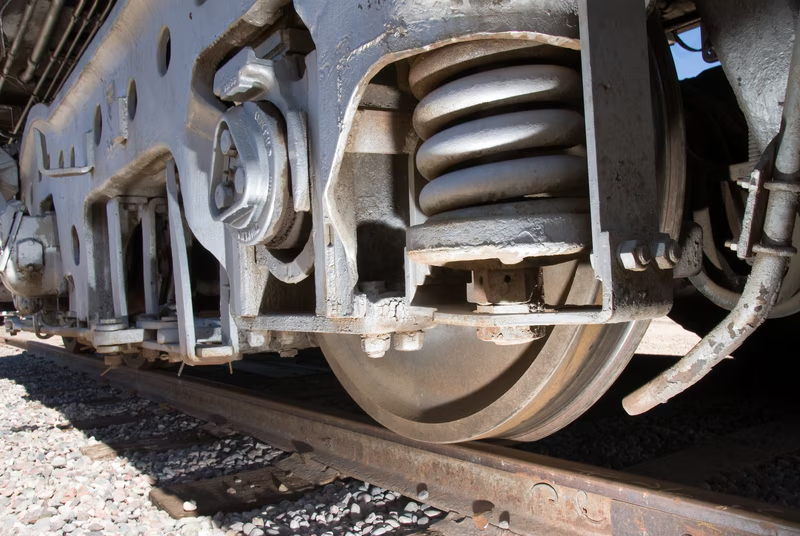
automatische smering vrachtwagen, chassissmering truck, smeersysteem oplegger, vijfdewielsmering, wielflenssmering, SKF EasyRail, centrale smering bus, smeersysteem vuilniswagen

56%

of premature bearing failures are caused by contamination and inadequate lubrication

More than half of your bearing damage is therefore a lubrication problem, not a bearing problem.

up to 33%

less lubricant consumption

By switching from manual to automatic lubrication. Less grease, precisely dosed, at the right moment.

30 min

per vehicle per maintenance cycle

That’s how much time correct manual lubrication of a commercial vehicle costs. Automation gives that time back to your workshop.

40–60%

of your maintenance costs stem from inadequate lubrication

While lubricants themselves account for only 2 to 3% of your operating costs. A hugely skewed ratio.

Why carriers and transport companies across the Benelux work with Euroquip

  • Official SKF partner — direct access to the full SKF and SKF Lincoln range, technical support and warranty terms.
  • Certified installation of lubrication systems — from system design and pipe routing to mounting, protected feed-throughs, commissioning and training your technicians.
  • Retrofit and new-build alike — we install systems on existing fleet and work together with body builders and outfitters on new vehicles.
  • Road and rail under one roof — chassis lubrication, body lubrication, wheel-flange lubrication and wayside systems from the same technical team.
  • On-site service across the full Benelux — periodic inspection, refilling, adjustment and fault follow-up planned around your route schedule.

Frequently asked questions

In the ROI model SKF applies to road transport, they factor in at least 95% fewer man-hours spent on lubrication, at least 50% fewer man-hours on repairs, and at least 50% lower replacement cost for slack adjusters and tie-rod ends. For rail: correct wheel-flange lubrication can double wheel service life; wayside rail lubrication extends rail life three to six times.

Sources: SKF publications on lubrication solutions for commercial vehicles and rail rolling stock.
Your results depend on fleet type, number of lubrication points, duty profile and your current lubrication practice — we map that out during a fleet scan.

Four levels of lubrication:
where does your fleet stand today?

Not every vehicle deserves the same level of lubrication. A trailer that runs twice a month calls for something different than a refuse truck making hundreds of pressing cycles a day, or a tram grinding its wheel flange against the rail in every tight curve. SKF builds the four levels modularly. Euroquip determines with you which level pays off fastest per vehicle type.
Level 1 · Basic

Manual lubrication

The right tool for the points you deliberately keep manual

  • SKF Lincoln 1882-E — 20V Li-ion cordless grease gun, for faster and more consistently dosed lubrication rounds in the workshop
  • 1142 / 1151 / 1035 — hand grease guns, also with a flexible hose for points only reachable from under the vehicle
  • LAGN 120 — grease fitting kit with 120 conical fittings, to standardize lubrication points across your entire fleet

Strong in: low investment, direct control, suited to vehicles with low annual mileage and easily accessible points.

Limits: correct manual lubrication takes about 30 minutes per vehicle per maintenance cycle — and that’s the time when every point is actually reached. Between two rounds the grease film runs dry and contamination gets in; over-grease it instead and you strain the seal and send excess grease onto the street or platform. Manual lubrication swings between too little and too much.

Level 2 · Consolidation

Semi-automatic lubrication

Bringing twenty-five lubrication points down to one

  • SSV — progressive divider block, distributes grease from one supply point across multiple outlet points in a fixed, verifiable sequence
  • SSVD — adjustable progressive divider block, for when the points need different amounts from one another
  • VPK — sectional progressive divider block for larger or mixed bodies
  • Armored, canvas, polyamide, steel tubing — pre-filled high-pressure hoses made to measure, plus plastic tubing, protected against stone chip and road salt

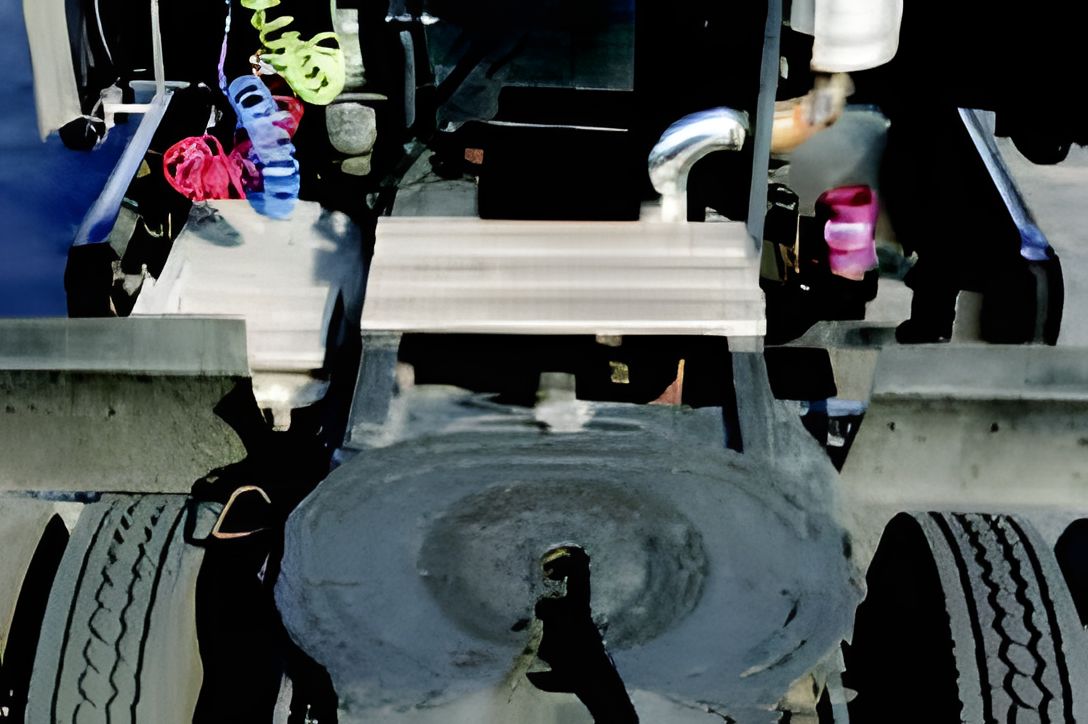
What it delivers: a trailer with up to 22 lubrication points is served through one central divider block. Instead of crawling under the vehicle and hunting point by point, your technician lubricates one accessible point on the chassis rail. Distribution is mechanical and forced: if one outlet blocks, the whole block stops.

Ideal for: trailers and semi-trailers with low usage, older vehicles where you’re not ready to go fully automatic yet, and workshops that want to halve the turnaround time of a lubrication round.

Level 3 · Continuous · Most chosen in road transport

Fully automatic lubrication

Lubricating while the vehicle is moving — exactly when the bearing needs it

For road vehicles:

  • CLP / PLP / P203 — electrically driven compact grease pumps for the chassis rail or heavy bodies
  • KFG — electrically driven grease pump, also as a reservoir and circulation unit
  • LMC 2 — control and monitoring unit for progressive and dual-line systems

For rail vehicles:

  • SKF EasyRail Compact / LP / HP — wheel-flange lubrication with spray nozzle, pump and curve sensor
  • SKF EasyRail Airless — for trams and metros with no compressed air (with electromagnetic PER pumps)
  • Wayside systems along the track — WIPER BAR and TOR BAR fed by solar-powered pumps

Why this matters heavily in transport: lubrication happens while the axle is turning. Dosing is fixed, so both running dry and over-greasing disappear. Frequent small doses actively flush dirt, road salt, dust and water out of bushings and bearings, instead of grinding it in. And your technicians no longer need to go under the vehicle for routine lubrication.

Smart detail (trailer with changing tractor units): the system sits on the trailer itself and runs off the brake-light power supply. A controller uses vibration measurement to track how long the trailer has actually been in use.

Level 4 · Data

Connected lubrication (SKF eLube / IoT)

See what your fleet is lubricating, without calling a single vehicle in

  • CLP / PLP Smart / P253 Smart — connected grease pumps with three operating modes: time-based, counter-based and progressive cycle-based
  • Datalog controller — compact controller enabling data logging and giving the driver control from the cab, readable via Bluetooth
  • SKF eLube app — connects automatically to all eLube products in range

What you do with it:

  • Read fill level, operating status and mode without lifting or stopping the vehicle
  • Spot a blocked line or empty reservoir within minutes instead of at the next round
  • Start a test lubrication cycle from your phone, for example at the handover of a retrofit
  • View a log of all faults and events; reports are saved automatically

Why this is relevant in transport: a fleet is spread out. The log shows that lubrication happened, when and how much. In a warranty claim (on a kingpin or slew ring), that’s the difference between assuming and proving. For rail there’s SKF Multilog IMx-Rail for rail-certified online condition monitoring.

ManualSemi-automaticFully automaticConnected
Lubricates while drivingnonoyesyes
Constant dosingnopartlyyesyes
Risk of over- and under-greasinghighmoderatelowlow
Labor time per cycle30 min/vehiclesignificantly reducedvirtually nonevirtually none
Fault detectiononly once damage or breakdown occursmechanically visiblecycle indicatorreal-time + alarm
Provable for warranty or auditpaper logbookpaper logbooksystem-drivendigital logbook

Want to know what your fleet loses every year to lubrication points that don’t get lubricated?

Give us the number of vehicles, the number of lubrication points per vehicle and your current lubrication frequency. We’ll convert man-hours, lubricant consumption, wear-part replacement costs and avoidable breakdowns into an annual figure — and set that against the investment in automatic lubrication.

No obligations. Response within two working days.

Lubrication solutions per vehicle type in your fleet

Every vehicle type has its own requirements: mileage and vibration, high cycle counts while the vehicle stands still, or steel-on-steel contact in tight curves. Below are four types Euroquip is asked about most often, with the critical components and the matching SKF setup.

Tractor-trailer combination


Why critical: a breakdown on the road costs multiples of the repair itself: towing costs, a replacement tractor unit, a missed loading slot and an unhappy customer. At the same time, these are the lubrication points most often skipped, because they sit under the vehicle and the tractor unit is usually out on the road when the round is scheduled.

Critical components: upper and lower kingpins, tie-rod ends, steering arms, cross-shafts of the linkage rods, spring shackle pins, brake camshaft bushings and slack adjusters front and rear, and the fifth wheel — where a correct grease film not only spares the coupling plate but also reduces tire wear.

Indicative number of lubrication points: 20 – 45 on the tractor unit and 10 – 22 on the trailer. (To be validated during the fleet scan; the exact number varies widely by manufacturer and build.)

Typical setup: a progressive system with a CLP or P203 pump on the chassis rail, a primary SSV block with cycle indicator and secondary SSV/SSVD blocks front and rear. Lines in splash zones are sheathed against stone chip and road salt. On mix-and-match combinations, the trailer gets its own unit running off the brake-light power supply.

Refuse trucks and high-cycle body vehicles


Why critical: here it’s not mileage that counts but the number of cycles. A rear loader makes hundreds of pressing and tipping movements per route, always with dirt, moisture and aggressive content in the immediate environment. If the vehicle goes down, the route goes down — and rescheduling a route costs more than the repair.

Critical components: bearings and hinge points of the pressing system, the loading hopper and payload area, hydraulic cylinder eyes, tipping mechanism and tailgate hinges, slew rings on side loaders, plus the classic chassis points of the undercarriage.

Indicative number of lubrication points: 30 – 70 for chassis and body combined. For comparison: SKF alone counts 28 or more points on a tipper. (To be validated during the fleet scan.)

Typical setup: the system can be part of the chassis lubrication or built as a separate unit for the body. A progressive system with CLP or P203, VPK divider blocks for the sectional body, and LGEP 2 or LGHB 2 as the grease — in urban and water-rich environments, LGGB 2 or LGTE 2.

Bus and coach


Why critical: a bus that breaks down leaves passengers stranded. In public transport, lubrication quality is also a comfort issue: squeaking hinges, stiff doors and a slew ring with play are noticed immediately. And at the periodic inspection, the steering and brake components are exactly the first checkpoints.

Critical components: steering knuckle and tie-rod ends, steering arms, spring shackle pins and bushings, brake camshaft bushings and slack adjusters, the slew ring of an articulated bus, and the hinge and guide points of doors, hatches and luggage compartment flaps.

Indicative number of lubrication points: 15 – 40 per vehicle, depending on two or three axles and whether a slew ring is present. (To be validated during the fleet scan.)

Typical setup: depending on the vehicle manufacturer’s recommendation, a single-line system on fluid grease, or a progressive system on consistent grease. The pump sits on the chassis frame and stays accessible via the engine hatch, so refilling and inspecting fit into the daily walk-around. All lines are protected against weather and splashing dirt.

Rail vehicle: tram, metro, train set and service rolling stock


Why critical: wear in the wheel-rail contact is the biggest cost item for any rail operator, and it climbs fastest in tight curves. Curve noise adds to that: the stick-slip effect on the railhead causes high-frequency squealing. Both are lubrication problems, each with its own solution: grease on the flange/wheel flange, a friction modifier on the railhead.

Critical components: wheel flanges and wheels, wheelset and bogie bearings, traction motor bearings, slew rings, buffer plates; along the track, the curves and switch areas.

Indicative number of lubrication points: on-board wheel-flange lubrication works with 2 – 4 spray nozzles on the first axle. The complete vehicle indicatively totals 10 – 30 lubrication points. (To be validated during the fleet scan.)

Typical setup: EasyRail Compact or LP for vehicles with compressed air, fitted with LCG3 control and a curve sensor. For rolling stock with no compressed air, there’s EasyRail Airless. To achieve the effect across several vehicles at once, add wayside systems in the curves (WIPER BAR, TOR BAR or SLID).

Do you also work with large oil systems?

Do you use large volumes of oil for hydraulics, gearboxes, or circulation in your processes? Avoid unnecessary oil changes and reuse your industrial oil indefinitely, without any loss of quality.

Lubricants and diagnostic tools for road transport and rail rolling stock

A lubrication system is only as good as the lubricant running through it. On a vehicle, that grease has to stay pumpable in frost, hold up under heavy load and vibration, resist water and road salt, and stay exactly where it belongs. Four choices that deliver on that in practice.

SKF LGEP 2 — high-pressure EP grease for chassis and body

Mineral oil, lithium soap, with EP additives. The workhorse for chassis points under heavy load and constant vibration.

Where it excels: excellent mechanical stability, very good corrosion protection and strong EP performance — exactly what a brake camshaft bushing, a spring shackle pin or a cylinder eye needs on a vehicle absorbing shocks all day long.

Typical application: the standard grease for chassis and body lubrication of tractor units, trailers, tippers and refuse trucks. Available from a 420 ml cartridge up to a 180 kg drum, so workshop stock and system filling share the same reference.

SKF LGWA 2 & SKF LGHB 2 — extreme performance

SKF LGWA 2 (wheel bearing grease): premium mineral oil, usable from −30 to +140 °C (peaks up to 220 °C). Where it excels: wheel bearings under heavy conditions and points close to the brake disc where temperature rises sharply. Good water resistance, ideal for road-salt/brine conditions.

SKF LGHB 2: high-viscosity grease with a calcium sulfonate complex thickener. Excellent for heavily loaded, slow-moving contact surfaces where the grease film has to hold up under heavy pressure, such as the fifth wheel, slew rings or the tipping system of a refuse truck. Its very good pumpability also makes it ideal for long pipe runs, even in the cold.

SKF LGGB 2 and LGTE 2 — for loss zones & the environment

LGGB 2: biodegradable, low-toxicity grease on a synthetic ester base. Very good cold-start behavior, good corrosion protection and suited to high loads.

LGTE 2: total-loss lubrication grease based on biodegradable esters, Ecolabel-certified. It adheres exceptionally well and washes away only minimally.

Why this matters for your fleet: in chassis, wheel-flange and rail lubrication, part of the grease is by definition total-loss — it doesn’t stay safely sealed inside a bearing. On a city route, along an open rail track, or at a distribution terminal with stormwater drainage, the lubricant’s environmental class is simply a hard permit requirement.

Diagnostic and dosing tools

SKF TLSD / LAGD single-point lubricators: automatic lubrication unit for an individual point. The wired TLSD only lubricates while the vehicle is in operation. The gas-driven LAGD is perfect for inaccessible points with no power supply.

SKF eLube app & Datalog: the diagnostic layer over your fleet. Status overview, fill levels and automatically saved data reports, simply read out with your smartphone, without driving the vehicle in.

SKF Multilog IMx-Rail: rail-certified online condition monitoring. Mounted in the bogie or the vehicle itself for advanced, real-time diagnostics.

Lubrication management by Euroquip: per vehicle type, we determine the right lubricant in the right amount, via an auditable lubrication plan for your workshop.

Get your fleet to the right lubrication level

Start with one vehicle type. We map the lubrication points, calculate what the current approach costs you annually in man-hours, wear parts and downtime, and propose the level that pays for itself fastest.

Do you also work with large oil systems at your facility (hydraulics or gearboxes)? Then also check out SKF RecondOil for circular oil use.

Response within two working days · Fleet scan on site or in your workshop · Service area: Belgium, the Netherlands and Luxembourg


Production
Nutrition
Agriculture
Earthmoving
Transport
Maritime
Paper
Steel
AutomoTIVE
Aviation
Mining
Recycling