
Your input changes with every load. Your lubrication can’t.

No sector feeds its machines a stream as unpredictable as this one. One load is light film and paper, the next contains an engine block, a gas cylinder or half a concrete lintel. On top of that comes dust that finds its way into everything, fibres that wrap around every shaft, leachate that attacks everything it touches, and an input that never stops because the containers keep coming. SKF and SKF Lincoln lubrication systems deliver a precisely dosed amount of grease to every point while your installation is running, keep dust and dirt out of the bearing with a constant grease flow, and keep your technicians away from moving blades and belts. Euroquip designs, installs and maintains them — on your fixed installations and on your collection and handling equipment alike.

Official SKF partner · Certified installation · Retrofit on existing sorting and shredder lines · Biodegradable greases available · Service throughout the Benelux
Voordelen van een efficient smeersysteem bij recyclage en afvalverwerking

56%

of premature bearing failures are caused by contamination and poor lubrication

More than half of your bearing damage is therefore a lubrication problem, not a bearing problem. In an environment that is dirty by definition, that share is not an outlier but the starting point.

up to 33%

less lubricant consumption

By switching from manual to automatic lubrication. Less grease, precisely dosed — and therefore also less grease ending up on the belt, in the material stream or on the sorting hall floor.

15–20 min

per machine per maintenance cycle

That’s how long correct manual lubrication takes. Automation gives that time back to your technicians and your planning — on a site where the inflow never stops, that’s not a luxury.

40–60%

of your maintenance costs stem from poor lubrication

While lubricants themselves account for only 2 to 3% of your operating costs. The ratio between effort and impact is rarely this lopsided.

Why recycling companies and waste processors in the Benelux work with Euroquip

  • Official SKF partner — direct access to the complete SKF and SKF Lincoln range, technical support and warranty terms.
  • Certified installation of lubrication systems — from system design and the choice between progressive, multi-line and dual-line to line routing, hose protection, commissioning and training of your technicians.
  • We know dirty, fibre-rich environments — retrofit on existing sorting, shredding and baling installations of various brands and vintages, mounting on vibrating parts, and systems that withstand dust, moisture and material impact.
  • Fixed installations and rolling equipment from a single partner — the same specialist who equips your sorting line also equips your collection vehicles, loaders and handling cranes. One lubrication plan, one grease strategy, one warehouse.
  • Installation within your shutdown window — we plan around your processing calendar and scheduled overhauls, not the other way around.

Frequently asked questions

In the ROI model that SKF applies, correctly lubricating a single machine with a grease gun costs around €350 per month in labour time, calculated at two minutes per lubrication point. With a manual centralised system that drops to around €140, and with a fully automatic centralised system to around €11. In the same model, correctly lubricated bearings last at least four times longer. And SKF is clear about the cause: poor lubrication causes more than 36% of all premature bearing failures — factor in contamination, and that rises above 50%.

Sources: SKF and SKF Lincoln publications on automatic lubrication systems, on conveying and crushing installations, and on commercial vehicles.
Your results depend on the number of installations, the number of lubrication points, operating hours and your current lubrication practice — we map this out during an installation scan.

Four levels of lubrication:
where does your processing line stand today?

Not every machine needs the same level of lubrication. A return drum on a short discharge belt needs something different from the rotor bearings of the pre-crusher that carries your entire input stream. SKF and SKF Lincoln build the four levels modularly, so you can choose per installation and expand later. Together with you, Euroquip determines which level pays off fastest and where.
Level 1 · Basic

Manual lubrication

The right tools for points you deliberately keep manual

  • SKF Lincoln 1882-E — 20 V Li-ion battery grease gun with two-speed gearing: high gear for volume, low gear for pressures up to 700 bar. Work light and status LEDs for loss of prime, empty cartridge or a blocked nipple
  • 1142 / 1151 / 1035 — manual grease guns, also available with flexible hose (1077600H) or as a complete set
  • LAGM 1000E grease meter — measures the actual amount of grease delivered per point; compatible with all SKF grease guns and suitable for most NLGI 0–3 greases

Strengths: low investment, no installation complexity, few components. Defensible on secondary equipment with limited operating hours and easily accessible points — a tensioning station at eye level, an outdoor discharge belt.

Limitations: in a processing hall, manual lubrication almost always means the line has to stop. You cannot enter a sorting line while it’s running, and the lubrication points of a shredder rotor, a screen drum or a baler plunger sit behind a guard that may only open after a full lockout procedure. Even without the statistics, every maintenance manager knows what happens then — the hardest point to reach is the first one skipped, and that’s usually exactly the point that’s critical.

Level 2 · Consolidation

Semi-automatic lubrication

Bringing fifteen points behind a guard down to one nipple in front of it

  • SSV — progressive divider block, distributes grease from a single supply point to multiple outlet points in a fixed, positive sequence
  • SSVD — adjustable progressive divider block, for when points require different quantities from one another — for example a heavily loaded rotor bearing next to a lighter guide roller
  • VPK — sectional progressive divider block for larger systems or ones spread across the installation
  • Armoured, canvas, polyamide, steel lines — custom-made in length and connection, with optional hose protection and customer-specific marking, so a technician on a sorting platform never has to guess which line goes where

What it delivers: instead of opening a guard, locking out a line and searching for fifteen separate points, your technician greases one central nipple in a safe, accessible location outside the danger zone. The distribution is mechanical and positive: if one outlet blocks, the entire block stops — so a fault becomes visible instead of going unnoticed until the bearing fails. The cycle indicator pin on the primary divider block gives you a visual confirmation that the system is working.

Ideal for: older sorting and shredding installations you don’t yet want to fully automate, mobile and relocatable units you move between sites, and all those points that are only accessible with a ladder, a scissor lift, or a fully shut down and locked-out line.

Level 3 · Continuous · Most popular in recycling and waste processing

Fully automatic lubrication

Lubricating while the shredder is running and the belt is full

  • CLP / PLP / P203 / KFG — electrically driven grease pumps that, depending on line length, serve up to 150 lubrication points; up to three pumping elements, various reservoir types, optional control board and level monitoring
  • AECP — automatic electric cartridge pump that works with standard 420 ml grease cartridges: refilling works just like a grease gun, no special tools needed. Compact, rugged and specifically designed to be retrofitted — on a second-hand sorting unit or a rented shredder, this is often the fastest step forward
  • P 205 / P 215 / ZPU — multi-line or dual-line systems for large stations with high consumption, available in ATEX versions
  • BPH — heavy-duty, hydraulically driven drum pump, the logical choice for refilling handling cranes and loaders

Why this matters so much in waste processing:

  • Lubrication takes place while the installation is running — exactly when the bearing needs the lubricating film, not when the maintenance window allows it
  • The constant grease flow actively pushes dust, fibres and moisture out, instead of pressing them in during a manual round
  • The dosing is fixed, so both under- and over-greasing disappear — and with it the grease that would otherwise end up on the belt and in your material stream via an over-greased bearing
  • Your technicians no longer need to go behind guards, along sorting platforms or under belt routes for routine lubrication

ATEX where it’s required: in zones with combustible dust — RDF production, wood processing, paper and film dust, dryers — SKF supplies components that meet the ATEX directive, for explosion group IIC/IIIC and protection level Gb/Db, with grease components rated up to 400 bar.

Level 4 · Data

Connected lubrication (SKF eLube / IoT)

See what every pump is doing without entering the hall

  • CLP / PLP Smart / P253 Smart — connected grease/oil pumps with three operating modes: time-controlled, counter-controlled and progressive cycle-controlled
  • Datalog controller — system controller with data logging, cab-based operation and a Bluetooth connection to the eLube app; compact enough to fit in a cab and suitable for proving the correct procedures were followed on rented, leased or pooled equipment
  • SKF eLube app — reads fill level, operating mode and pump status wirelessly, without stopping the installation or physically accessing the pump

What you can do with it:

  • Spot a blocked line or a nearly empty reservoir within minutes instead of at the next round — and step in before the bearing suffers damage
  • Configure and share pump settings with a colleague, a subcontractor or your service partner
  • Keep a log of cycles, consumption and faults, with automatically saved reports

Why this is relevant in a processing company: your sorting hall is not a place you casually walk into just to read a fill level. There’s dust, there’s noise, there’s moving equipment, and there are guards that can’t simply be opened. Every check you can do from a tablet in the office instead of on site is one less entry and one less risk moment. Work across multiple sites, a transfer station and a processing centre, or with relocatable units on location per project, and that argument only gets stronger: physically going to check whether a pump still has grease is the most expensive form of monitoring there is.

Voordelen van een efficient smeersysteem bij recyclage en afvalverwerking

ManualSemi-automaticFully automaticConnected
Lubrication during operationno, line must stoplimitedyesyes
Consistent dosingnopartlyyesyes
Risk of over- or under-greasinghighmoderatelowlow
Grease in the material streamreal risklimitedvirtually excludedvirtually excluded
Labour time per cycle15–20 min/machinegreatly reducedvirtually zerovirtually zero
Actively pushing dirt out of the bearingnopartlyyesyes
Fault detectiononly once damage occursmechanically visiblevia the systemreal-time + alarm
Technician safetylockout, guard openlimitedno entry requiredno entry required
Traceability of the lubrication roundpaper logbookpaper logbooksystem-controlleddigital logbook

Want to know what your site loses every year to lubrication points that don’t get greased?

Tell us the number of installations and vehicles, the number of lubrication points, your current lubrication frequency, and what an hour of unplanned downtime costs you in unprocessed tonnes. We convert the labour time, grease consumption, bearing replacement and avoidable downtime into an annual figure — and set the investment in automatic lubrication alongside it.

No obligations. Response within two working days.

Lubrication solutions per installation type in recycling and waste processing

Every step in the processing chain has its own lubrication profile: the load, the speed, the contamination and the accessibility vary widely. Below are the four groups Euroquip is asked about most often, with their critical components and the matching SKF solution.

Pre-crushers, shredders and granulators


Why it’s critical: this is the machine your entire process stands or falls on, and at the same time the machine with the most unpredictable load profile on the site. Every load delivers a shock load that the rotor bearings absorb directly, while a shredder rotor turns slowly under very high load — the exact situation where a bearing never builds up a proper hydrodynamic lubricating film.

Critical components: rotor and main shaft bearings, drive bearings and coupling, gearbox and belt-tensioning station, counter-blade and cutter-rotor bearings, the hydraulic pusher and feed mechanism, hinge points of the flap covers.

Indicative number of lubrication points: 12 – 40 points per shredder or granulator line, increasing with the feed table, discharge belt and drive station. (To be validated during the installation scan.)

Typical setup: a progressive system with a CLP or P203 pump and SSV/SSVD divider blocks, with the pump on a low-vibration part of the frame and flexible high-pressure hoses to the moving parts. For a heavier-duty machine or several machines in one hall, a P 215 multi-line pump or a dual-line system with a ZPU pump comes into play. Grease: LGEV 2 or LGEM 2 for the slow-turning, heavily loaded rotor bearings, LGHB 2 where temperature and water ingress meet, and LGEP 2 for the classic EP points.

Sorting lines: conveyor belts, trommel screens and separators


Why it’s critical: the sorting line is the longest, most spread-out and most overlooked part of your installation. In a sorting hall, something else is added to that: fibres. Film, textile, rope and paper dust wrap themselves around shafts and then pull the grease out of the bearing. With trommel screens, constant vibration and imbalance add to that.

Critical components: drive and return drum bearings, tensioning drums and tensioning stations, carrier and return idler stations, the bearings and drive of the trommel screen, the unbalance drive and rocker-shaft bearings of ballistic separators.

Indicative number of lubrication points: 40 – 250+ per sorting line, depending on the number of belt segments, screens and separation stages. (To be validated during the installation scan.)

Typical setup: for a single belt segment, a progressive system with a P203 pump and SSV/VPK divider blocks. For a complete sorting line under one roof: a dual-line system with a ZPU pump, or a sectional design with a central drum pump and EDL1 booster pumps per line section. Where piping over a long belt bridge or to a vibrating screen housing is impractical: TLSD single-point lubricators. Grease: LGWA 2 for high loads in wet conditions, LGWM 1 where good pumpability over long lines and at low temperature matters, and LGHB 2 where water and leachate are structurally present.

Balers, compactors and heavy conveyor chains


Why it’s critical: a baler or compactor has an extremely cyclical load profile: build up high pressure, ram through, retract, repeat. On compactors at a transfer station, leachate is added to that: moisture from the waste stream runs to the lowest (and hardest to reach) points of the machine. For heavy compost or drag chains, SKF also states that brush systems are unsuitable and grease injection is often the only solution.

Critical components: plunger and ram guides, main bearings and connecting-rod bearings of the press drive, hinge points of the pre-press and lid mechanisms, and for chain conveying, the chain links themselves, sprockets and head and tail shaft bearings.

Indicative number of lubrication points: 20 – 70 per press or compactor unit, and 10 – 40 per heavy chain run. (To be validated during the installation scan.)

Typical setup: a progressive system with a CLP or P203 pump and SSV/SSVD blocks for the bearing and hinge points, positioned so the divider blocks stay above the leachate level. For heavy chains: GIS-B or GIS-C compressed-air-driven grease injection systems that deliver grease directly into the chain hinge. Grease: LGHB 2 where high load, temperature and water ingress meet, and LGEM 2 on the slowest, most heavily loaded hinge points.

Collection and handling equipment: refuse trucks, wheel loaders and handling cranes


Why it’s critical: a collection vehicle makes hundreds of stops a day and, besides a heavily loaded chassis, has a body with a compaction cycle that hinges with every emptying. Let dirt and grit work their way in here, and an abrasive paste forms in the bearing. On a wheel loader in the bunker hall, rapid direction changes and heavy, varying loads add to that. And manually lubricating the slew ring of a handling crane can take up to half an hour per round and carries serious safety risks.

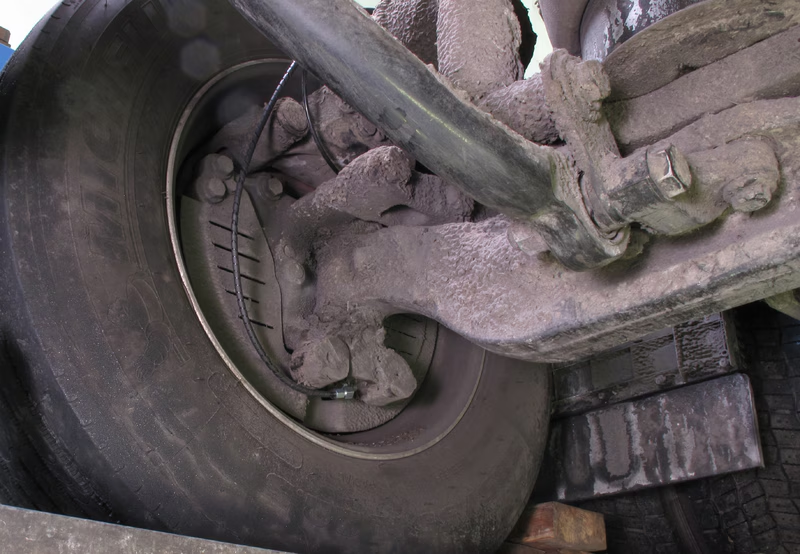
Critical components: kingpins, tie-rod ends, spring-leaf bolts, brake cams and the ram-guide slides, plate and slide hinges of the body. On the handling crane: the slew ring and slewing gear, boom hinges and the rotator.

Indicative number of lubrication points: 25 – 60 points per collection vehicle including the body, 23 – 50 per wheel loader and 20 – 45 per handling crane. (To be validated during the installation scan.)

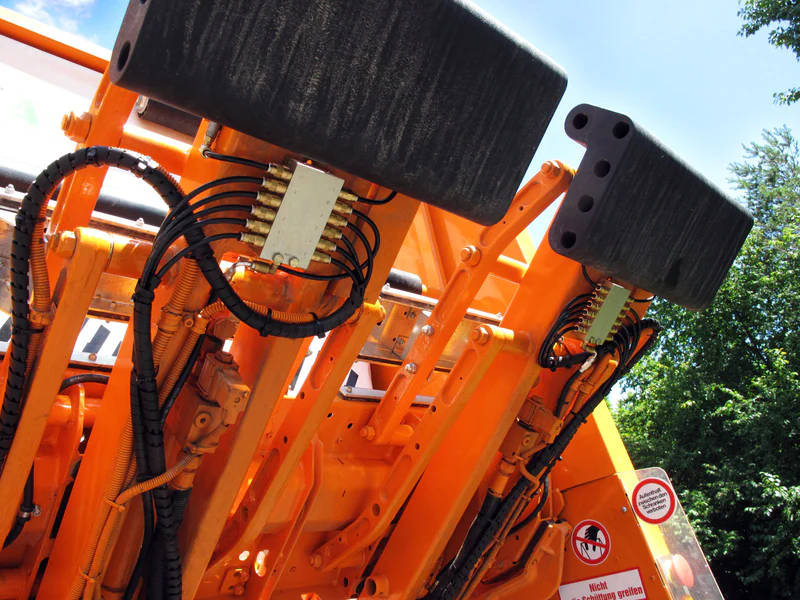
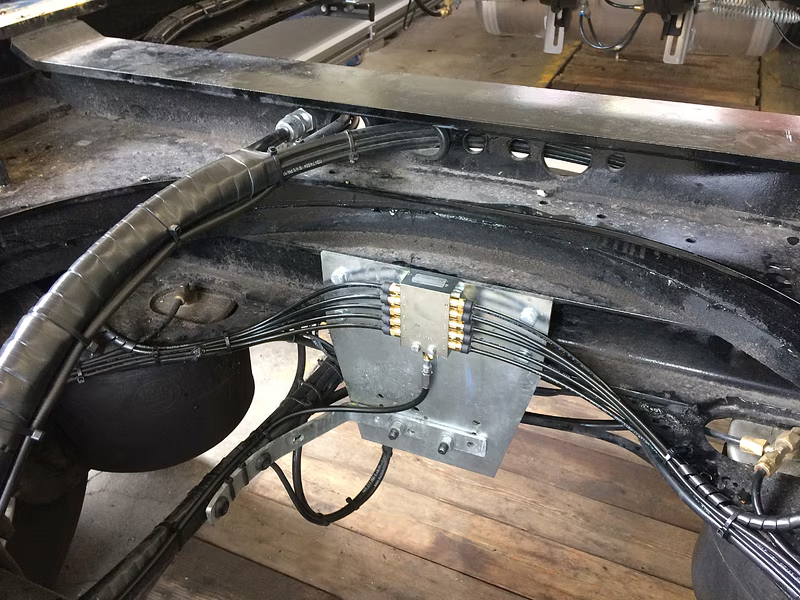
Typical setup: a progressive system with a CLP or P203 pump. On a collection vehicle, the pump sits on the chassis frame; the body can be lubricated independently or as part of the same circuit. Refilling is done with a BPH hydraulically driven drum pump. To monitor the fleet remotely, choose CLP Smart or P253 Smart with the Datalog controller. Grease: LGWM 2 for heavy off-road applications in wet conditions, LGWA 2 for heavily loaded wheel bearings, and LGGB 2 or LGTE 2 for environmentally sensitive applications.

Do you also work with large oil systems?

Do you use large volumes of oil for hydraulics, gearboxes, or circulation in your processes? Avoid unnecessary oil changes and reuse your industrial oil indefinitely, without any loss of quality.

Lubricants and diagnostic tools for sorting, shredder and processing installations

A lubrication system is only as good as the grease that runs through it. In a processing company, that grease has to do four things at once: carry shock loads at low speeds, keep dust and fibres out of the bearing contact, withstand moisture and aggressive leachate, and remain pumpable over long line runs and through the winter.

SKF LGEM 2 and LGEV 2 — high viscosity with solid lubricants

LGEM 2 is a high-viscosity grease with solid lubricants that bridges the lack of hydrodynamic film at points that turn slowly under high load. LGEV 2 is the heavier variant with an extremely high-viscosity base oil, molybdenum disulfide and graphite, designed for large trunnion bearings under heavy vibration.

Where this matters in your installation: rotor bearings of shredders and granulators, eccentric and pin joints of pressing and dosing mechanisms, the slowest bearings of trommel screens and heavy chain conveying, and the pin joints of handling cranes and loaders.

Point to watch: greases with solid lubricants may only be used in a centralised lubrication system after technical consultation. Euroquip validates this per system design.

SKF LGHB 2 and LGWA 2 — moisture, leachate and high loads

LGHB 2: High-viscosity grease that excels where water is unavoidable: leachate in the bunker and under the press, rainwater on an outdoor installation, wash systems in plastics recycling, and the damp atmosphere in a composting hall. Protects against peaks up to 200 °C and remains very pumpable.

LGWA 2: Premium grease for operating temperatures from −30 to +140 °C. The workhorse grease for belt drums, wheel bearings on rolling equipment, and heavily loaded, slow-turning points in wet conditions.

SKF LGGB 2, LGTE 2 and the LGWM range

LGGB 2 (EAL): Biodegradable grease, ideal for composting or digestion installations where grease traces in the end product are undesirable. LGTE 2 is the Ecolabel alternative for total-loss applications such as open chains.

LGWM 1 and LGWM 2: The pumpability specialists. LGWM 1 is essential for long line runs along a sorting line that also needs to flow reliably in January. LGWM 2 is designed for high loads, wet environments and false-brinelling protection (e.g. equipment that stands idle for long periods).

Diagnostic and dosing tools

SKF TLSD / LAGD single-point lubricators: Ideal for automating a long belt run or a spread-out installation step by step, without laying piping right away. The status LEDs are visible from every side, allowing checks straight from the floor.

SKF Lincoln 1882-E: Battery grease gun rated up to 690 bar for manual points, combined with a grease meter that measures the actual amount delivered (the only way to determine the re-greasing quantity with precision).

SKF eLube & Datalog: For wireless monitoring and alerts.

Bring your processing line to the right lubrication level

Start with one machine — usually the shredder or the sorting line with the highest downtime cost. We map the lubrication points, calculate what the current approach costs you each year in labour, grease, bearings and unprocessed tonnes, and propose the level that pays for itself the fastest.

Do you also work with large oil systems in your plant — hydraulics, gearboxes, circulation oil? Then take a look at SKF RecondOil for circular oil use.

Response within two working days · On-site installation scan · Service area: Belgium, the Netherlands and Luxembourg


Production
Nutrition
Agriculture
Earthmoving
Transport
Maritime
Paper
Steel
AutomoTIVE
Aviation
Mining
Recycling