
Lubrication that keeps your steel line running — through 24/7 operation, radiant heat and rolling water

Few industries make such demands on a bearing as a steel plant: temperature, speed, high and constant shock loads, abrasive dust, aggressive chemistry and high humidity — often all six at once, at the same lubrication point. SKF and SKF Lincoln lubrication systems bring hundreds to thousands of those points under one controlled dose, while the installation keeps running. Euroquip designs, installs and maintains them on your line.

Official SKF partner · Certified installation · Corrosion-resistant and stainless-steel versions · Installation during scheduled shutdowns · Service throughout the Benelux
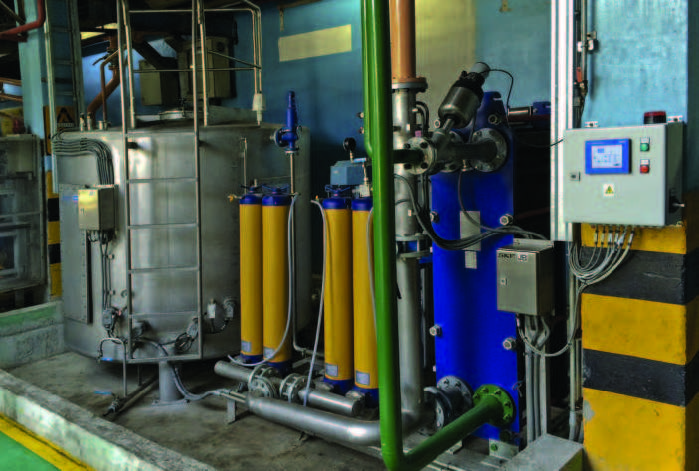
SKF Lincoln smeersystemen voor de staalindustrie

56%

of premature bearing failures are caused by contamination and poor lubrication

More than half of your bearing damage is therefore a lubrication problem, not a bearing problem.

up to 33%

less lubricant consumption

By switching from manual to automatic lubrication. Less grease, precisely dosed, at the right moment.

15–20 min

per machine per maintenance cycle

That’s how long correct manual lubrication takes. Automation gives that time back to your technicians — and to your production planning.

40–60%

of your maintenance costs stem from poor lubrication

While lubricants themselves account for only 2 to 3% of your operating costs. The ratio between effort and impact is rarely this lopsided.

Why steel companies and foundries in the Benelux work with Euroquip

  • Official SKF partner — direct access to the complete SKF and SKF Lincoln range, technical support and warranty terms.
  • Certified installation of lubrication systems — from system design and material selection for hot, dusty and wet zones to piping, commissioning and training your team.
  • We know continuous operation — a steel line doesn’t wait. We plan pre-fabrication and pre-assembly so the effective installation time fits within your shutdown window, and work around a casting sequence where needed.
  • We think per zone, not per machine — the casting strand, the rolling line, the conveying chain and the lifting equipment each get their own system and lubricant choice, in one coherent lubrication plan.
  • On-site advice and maintenance — periodic inspection of your lubrication system, refilling, adjustment and fault follow-up through a single point of contact across the entire Benelux.

Frequently asked questions

Scale is the whole point in this sector. SKF dual-line systems dose a precisely measured amount of grease to up to 2,000 lubrication points over distances of 120 metres and more, at pressures up to 400 bar — and if one outlet pair in a metering element blocks, the remaining points simply keep getting lubricated. SKF explicitly names steel mills, metalworking companies and cement plants as application areas, including the conditions that come with them: high back-pressure at the lubrication point, dirty, wet or humid environments, and low temperatures.

Sources: SKF publications on lubrication systems and lubricants for the metals industry, including the sector brochure for the metals industry.
Your results depend on the number of lubrication points, line utilisation and your current lubrication practice — we map this out during an installation scan.

Four levels of lubrication:
where does your installation stand today?

Not every lubrication point deserves the same regime. A gearbox in the drive pit needs something different from a roller-conveyor bearing next to a glowing slab. SKF builds the four levels modularly, so you can expand per line or per unit without replacing everything at once. Together with you, Euroquip determines which level pays off fastest per zone.

Level 1 · Basic

Manual lubrication

The right tools for points you deliberately keep manual

  • SKF Lincoln 1882-E — 20 V Li-ion battery grease gun with two-speed gearing: the high setting moves large amounts of grease quickly, the low setting delivers up to 700 bar peak pressure for stubborn, seized-up nipples.
  • 1142 / 1151 / 1035 — pistol-grip, lever and double-lever grease guns for points with generous intervals.
  • LAGC S grease coupler & LAGN 120 nipple kit — stays locked onto the nipple while lubricating (up to 550 bar) and standardises all your lubrication points.

Strengths: low investment, direct control, suitable for points with generous intervals and good accessibility.

Limitations: servicing a single lubrication point manually takes an average of two minutes. Multiply that across a rolling line with hundreds of points, and the round no longer fits within a scheduled shutdown. What’s more, a lubrication round along a roller conveyor or a ladle crane runway means: radiant heat, mill scale and moving masses right where your technician is standing.

Level 2 · Consolidation

Semi-automatic lubrication

Bringing multiple lubrication points together into one accessible point

  • SSV / SSVD — (adjustable) progressive divider blocks that split the grease flow into predetermined amounts, usable under high back-pressure (up to 350 bar).
  • VPK — sectional progressive divider block.
  • Armoured, canvas, polyamide, steel lines— custom-made, with spiral, spring or corrugated-tube protection for runs along hot or mechanically stressed zones.

What it delivers: instead of searching for fifteen separate points between roll stand and drive side, your technician lubricates one central point at working height, outside the hot zone. The distribution is mechanical and positive: if one outlet blocks, the entire block stops.

Ideal for: lubrication points in the radiant heat zone, points behind a guard, or units you don’t yet want to invest in making fully automatic. Later, this is easy to connect to a pump.

Level 3 · Continuous · Most popular in continuous operation

Fully automatic lubrication

The right lubricant, in the right amount, at the right moment — with no one involved

  • Single-line systems — for slabbing mills, piercing mills, wire rod mills and blast furnaces.
  • Progressive systems — for transfer cars, cranes and ladle turrets.
  • Dual-line systems — for coilers, cold roll stands, continuous casting installations and roller conveyors.
  • Oil-air lubrication & SKF CircOil — for sensitive bearings, straighteners, metering rolls and converter drives.
  • Grease injection for chains (GVP) — injects grease under pressure directly into the chain pins while the chain is moving.

Why this matters so much in heavy industry: Lubrication takes place while the installation is running — exactly when the bearing needs it, with no shutdown required. Excess grease in a dusty or hot zone is also a fire and environmental risk, not a cosmetic issue. Your technicians no longer need to enter the radiant heat zone, go under a roller conveyor, or climb onto a crane runway for routine lubrication.

Level 4 · Data

Connected lubrication (SKF eLube / IoT)

See what your lubrication system is doing, without stopping the line

  • CLP / PLP Smart / P253 Smart — connected grease pumps with operating modes: time-controlled, counter-controlled and progressive cycle-controlled.
  • Datalog controller — logs lubrication data and communicates via Bluetooth.
  • SKF eLube app & Web Gate — reads fill levels wirelessly and delivers alarm confirmations (e.g. via SMS).

What you can do with it:

  • Read fill level and operating status without shutting down the installation or physically walking to the pump — saving a trip through a hot zone.
  • Spot a blockage or an empty reservoir instead of at the next round.
  • Step in before the bearing suffers damage, instead of after.

Why this is relevant here: A steel company runs continuously, and the critical lubrication points often sit exactly where no one goes unplanned. Remote reading replaces the inspection round that would otherwise have to happen next to a glowing slab.

SKF Lincoln smeersystemen voor de staalindustrie

ManualSemi-automaticFully automaticConnected
Lubrication during operationnot in practicelimitedyesyes
Consistent dosingnopartlyyesyes
Points in hot or dusty zoneentry requiredbrought to a safe zoneno access neededno access needed
Labour time per cycle15–20 min/machinegreatly reducedvirtually zerovirtually zero
Fault detectiononly once damage occursmechanically visiblevia the systemreal-time + alarm
Traceabilitypaper logbookpaper logbooksystem-controlleddigital logbook

Want to know what your installation costs every year in lubrication points that don’t get greased?

Tell us the number of units, the number of lubrication points and your current lubrication frequency. We convert the labour time, lubricant consumption and avoidable downtime into an annual figure — and set the investment in automatic lubrication alongside it. One hour of unplanned downtime on a rolling line outweighs a whole year’s grease budget.

No obligations. Response within two working days.

Lubrication solutions per installation in your steel plant or foundry

From liquid steel to coiled coil, your product passes through four completely different lubrication environments: red-hot, soaked with rolling water, extremely heavily loaded and slow-turning, or fast and sensitive. Below are the four zones Euroquip is asked about most often, with their critical components and the matching SKF solution.

Continuous casting installation


Why it’s critical: the continuous caster is the bottleneck between steelmaking and hot rolling. An unplanned stop disrupts the entire upstream heat chain. The conditions are unforgiving: roll segment bearings work right next to the cast product in radiant heat, while secondary cooling constantly hits them with water.

Critical components: casting roll bearings, oscillation table, mould, ladle turret, run-out and straightening rolls, slab conveying.

Indicative number of lubrication points: typically 150 – 600 per casting strand (To be validated during the installation scan).

Typical setup: Dual-line systems, specifically designed for many points over long distances under high back-pressure. Oil-air lubrication for the rolls and roll segment bearings, and LGHB 2 grease for heavily loaded wet positions.

Hot and cold rolling line with roll stand bearings


Why it’s critical: the rolling line is the zone with the highest downtime cost per hour and the heaviest dynamic load. Constant shock loads, rolling water, mill scale and radiant heat on the hot side. A single drop of spilled grease on the strip on the cold side is instant quality loss.

Critical components: roll stand bearings, backup roll plain bearings, drive gearboxes, coilers, straighteners and roller conveyors.

Indicative number of lubrication points: typically 200 – 800 per rolling line (To be validated during the installation scan).

Typical setup: Dual-line systems for the grease-lubricated positions, combined with circulation lubrication (SKF CircOil) for the drive side (lubricates and cools the gears at the same time). Oil-air lubrication for the mill bearings.

Blast furnace, sinter plant and conveying installations


Why it’s critical: this is the zone where abrasive dust turns the lubricant itself into a grinding compound. Ore, coke, lime and sinter generate fine dust that, combined with moisture and grease, forms an abrasive paste. The failure of a single conveyor belt shuts down the supply to an entire furnace.

Critical components: material and bunker gates, furnace fans, drive and return stations of conveyor belts, open gear drives.

Indicative number of lubrication points: 100 – 400 per conveying line or furnace zone (To be validated during the installation scan).

Typical setup: Single-line systems for material gates, progressive systems for furnace fans. SKF GVP or Lincoln COBRA for direct grease injection into the chain pins while running. LP2/LPC lubricating gears for open gear drives (no spray mist).

Ladle cranes, lifting equipment and roller conveyors


Why it’s critical: cranes and roller conveyors are the installations where safety and availability collide the hardest. A jammed wheel on a ladle crane full of liquid steel is not a maintenance problem, it’s an incident. These hard-to-reach points are the ones most often skipped manually.

Critical components: crane wheels, sheaves, hoist and travel drives, slew rings, cable drum bearings and hinge points of ladle tilters.

Indicative number of lubrication points: typically 40 – 150 per crane and 60 – 300 per roller conveyor section (To be validated during the installation scan).

Typical setup: Progressive systems for cranes (one pump serves the whole crane, no more climbing) and single-line or dual-line for roller conveyors. The LP2 lubricating gears treat the slew rings safely and evenly.

Do you also work with large oil systems?

Do you use large volumes of oil for hydraulics, gearboxes, or circulation in your processes? Avoid unnecessary oil changes and reuse your industrial oil indefinitely, without any loss of quality.

Lubricants and diagnostic tools for steel production and heavy industry

A lubrication system is only as good as the lubricant that runs through it. In a steel company, that lubricant has to handle four things at once that technically work against each other: withstand high temperature, carry extreme and shock-type loads, resist water ingress, and still remain pumpable over long line runs. Rarely can that be achieved with a single product for the whole plant.

SKF LGHB 2 — high load, high temperature

High-viscosity grease with a calcium sulfonate thickener (KP2N-20). Designed for the combination that is standard in heavy industry: heat and extreme load.

Where it excels: Withstands peaks up to 200 °C, has excellent oxidation resistance and corrosion protection — even with significant water ingress. Very good pumpability, which makes it suitable for long line runs in central systems.

Typical application: casting roll bearings, oscillation tables, roll stand positions where heat and rolling water come together.

SKF LGEV 2 & LGEM 2 — extreme load, slow rotation

LGEV 2: Contains solid lubricants (MoS₂ and graphite) combined with an extremely high-viscosity oil. Exceptionally suited to lubricating large trunnion bearings under high load and slow rotation (micro-slip), such as a ladle turret or a slow-turning casting roll.

LGEM 2: The choice for heavily loaded, slow-turning positions where you need a load-bearing film that holds up even at standstill and restart. Solid lubricants take over the job once the standard film gets too thin.

SKF LGWA 2, LGEP 2 & the LGWM range

LGEP 2: The ultimate roll stand grease. Very strong EP performance and mechanical stability under shock and vibration. SKF literally recommends this for work roll bearings and crane wheels in the steel industry.

LGWA 2: Premium grease for peaks up to 220 °C. Recommended when load or temperature falls outside the range of a universal grease.

LGWM 1 / LGWM 2: Stay remarkably pumpable at low (outdoor) temperatures and offer strong false-brinelling protection — essential for standby cranes and installations that stand idle for long periods in the cold.

Diagnostic and dosing tools

SKF TLSD single-point lubricator: For isolated points. You position the unit itself outside the hot or dusty zone (with a hose from 1 to 5 metres), and it lubricates automatically.

LAGM 1000E & TLGU 10: The grease meter that actually measures the delivered dose. The TLGU 10 uses ultrasound so the technician stops lubricating at the exact moment the bearing is full (no more over-dosing!).

SKF eLube & Datalog: For the connected systems. Read fault alarms via SMS or Bluetooth and avoid unnecessary and dangerous physical inspection rounds.

Bring your installation to the right lubrication level

Start with one zone. We map the lubrication points, calculate what the current approach costs you each year, and propose the level that pays for itself the fastest.

Do you also work with large oil systems in your plant — hydraulics, gearboxes, circulation oil? Then take a look at SKF RecondOil for circular oil use.

Response within two working days · On-site installation scan · Service area: Belgium, the Netherlands and Luxembourg

Production
Nutrition
Agriculture
Earthmoving
Transport
Maritime
Paper
Steel
AutomoTIVE
Aviation
Mining
Recycling