
Lubrication that keeps your food line running — and your product safe

In food and beverage production, every stoppage is a lost batch. SKF lubrication systems with NSF H1 food grade lubricants lower your maintenance costs, extend the life of bearings and chains, and eliminate the risk of over-lubrication and product contamination. Euroquip designs, installs and maintains them on your line.

Official SKF partner · NSF H1 · ISO 21469 · Halal & Kosher · Installation during planned stops · Service across the full Benelux
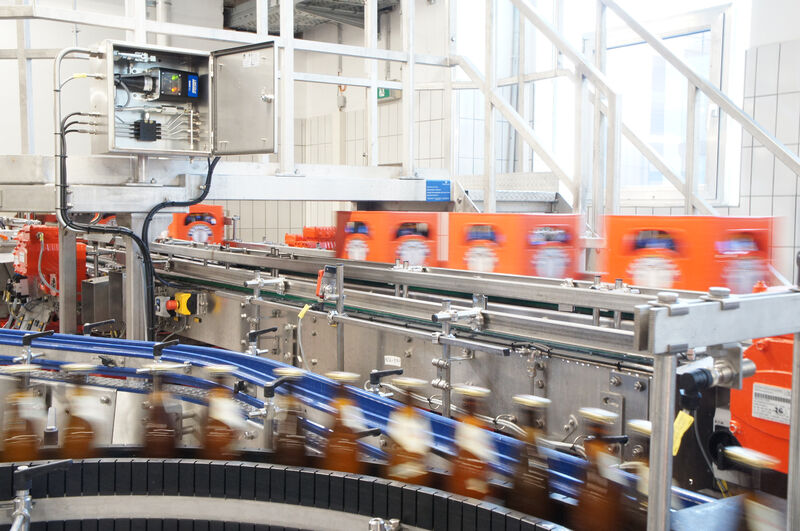
Voorbeeld van een smeerysteem in de voedingssector, hier in de Erdinger brouwerij.

56%

of premature bearing failures are caused by contamination and inadequate lubrication

More than half of your bearing damage is therefore a lubrication problem, not a bearing problem.

up to 33%

less lubricant consumption

By switching from manual to automatic lubrication. Less grease, precisely dosed, at the right moment.

15–20 min

per machine per maintenance cycle

That’s how much time correct manual lubrication costs. Automation gives that time back to your technicians — and to your production planning.

40–60%

of your maintenance costs stem from inadequate lubrication

While lubricants themselves account for only 2 to 3% of your operating costs.

Why food producers across the Benelux work with Euroquip

  • Official SKF partner — direct access to the full SKF and SKF Lincoln range, technical support and warranty terms.
  • Certified installation of lubrication systems — from system design and stainless-steel execution for wet zones to piping, commissioning and training your team.
  • We know food environments — high-pressure cleaning, zoning, NSF H1 requirements and the distinction between what’s allowed in incidental product contact and what isn’t.
  • Advice and maintenance on site — periodic inspection of your lubrication system, refilling, adjustment and fault follow-up through a single point of contact.
  • Installation within your shutdown window — we plan around your production calendar, not the other way around.

Why food producers across the Benelux work with Euroquip

In bottling plants, SKF has seen applications where automatic lubrication cut downtime by up to 80% and annual spare-parts consumption — bearings, chains, gears — fell by an average of around 50%. On rinsers, downtime reduction reached as high as 86%.

Sources: SKF publications on lubrication solutions for the food and beverage industry.
Your results depend on line occupancy, number of lubrication points and your current lubrication practice — we map that out during a line scan.

Four levels of lubrication:
where does your line stand today?

Not every machine deserves the same level of lubrication. A rarely accessed lubrication point in a dry zone calls for something different than a carousel running 24 hours a day. SKF builds the four levels modularly, so you can expand step by step. Euroquip determines with you which level pays off fastest per machine.
Level 1 · Basic

Manual lubrication

The right tool for points you deliberately keep manual

  • SKF Lincoln 1882-E— 20V Li-ion cordless grease gun, for faster and more consistently dosed lubrication rounds
  • 1142 / 1151 / 1035 — pistol-grip, lever and double-lever grease guns for lower frequencies
  • LAGN 120 — grease fitting kit with 120 conical fittings, for standardizing your lubrication points across the entire line

Strong in: low investment, direct control, suited to points with generous intervals and good accessibility.

Limits: dosing depends on whoever does the round. Too much grease contaminates your product and your zone, too little lets the bearing run dry. And with 24-hour production, that round has to happen while the machine is running — with all the safety risks that entails.

Level 2 · Consolidation

Semi-automatic lubrication

Bringing multiple lubrication points together into one

  • SSV — progressive divider block, distributes grease from one supply point across multiple outlet points in a fixed, verifiable sequence
  • SSVD — adjustable progressive divider block, for when lubrication points need different amounts from one another
  • Armored, canvas, polyamide, steel tubing — custom-made for your machine layout

What it delivers: instead of hunting for and operating fifteen points separately, your technician lubricates one central point. Distribution happens mechanically and forcibly: if one outlet blocks, the whole block stops — so a fault becomes visible instead of going unnoticed.

Ideal for: machines with hard-to-reach points, wet zones where you’d rather not stand with a grease gun, and lines where you’re not yet ready to invest in fully automatic.

Level 3 · Continuous · Most chosen in F&B

Fully automatic lubrication

The right lubricant, in the right amount, at the right moment — with no one involved

  • CLP / PLP — electrically driven compact grease pump for small to medium progressive systems
  • P203 — electrically driven oil/grease pump for larger systems and sectional setups
  • ETP — electrically driven compact lubrication unit
  • EDL1 — electric grease booster pump for long pipe runs or higher back-pressure
  • CLK — electrically driven oil-based chain lubrication kit
  • OCL-M — shaft-driven chain lubrication kit, for chains that only need lubrication while actually running
  • Lubrigun — compressed-air-driven drum pump for sectional systems across a full bottling line

Why this matters heavily in food:

  • Lubrication happens while the machine is running — exactly when the bearing needs it
  • Dosing is fixed, so over-lubrication and its contamination risk disappear
  • Your technicians no longer need to enter moving zones for routine lubrication
  • The lubrication round disappears from the critical path of your planned stops

Practical effect: a bottling line can up to double the speed of a spiral conveyor, because automatically lubricated transmission chains can run faster without damaging bottles.

Stainless-steel execution: components in wet zones are made of stainless steel or housed in a stainless enclosure, so they withstand high-pressure cleaning and stay corrosion-free.

Level 4 · Data

Connected lubrication (SKF eLube / IoT)

See what your lubrication system is doing, without stopping the machine

  • CLP / PLP Smart — connected compact grease pump with three operating modes: time-based, counter-based and progressive cycle-based
  • P253 Smart — connected oil/grease pump with up to three pump elements and various reservoir sizes
  • SKF eLube app — connects automatically to all eLube products in range

What you do with it:

  • Read fill level, operating status and mode without entering or stopping the line
  • Spot a blocked line or an empty reservoir within minutes instead of at the next round
  • Start a test lubrication cycle from your phone
  • A log of all faults, warnings and events; reports are saved automatically and emailed
  • Each user logs in individually, so actions in the status reports are traceable — valuable for audits

Why this is relevant in food: the log shows that lubrication happened, when, and with what dose. In an audit or a complaint investigation, that’s the difference between assuming and proving.

smeerysteem-in-voedingsindustrie
ManualSemi-automaticFully automaticConnected
Lubricates during operationriskylimitedyesyes
Constant dosingnopartlyyesyes
Risk of over-lubricationhighmoderatelowlow
Labor time per cycle15–20 min/machinesignificantly reducedvirtually nonevirtually none
Fault detectiononly once damage occursmechanically visiblevia systemreal-time + alarm
Provable for auditpaper logbookpaper logbooksystem-drivendigital logbook

Want to know what your line loses every year to lubrication points that don’t get lubricated?

Give us the number of machines, the number of lubrication points and your current lubrication frequency. We’ll convert labor time, lubricant consumption and avoidable downtime into an annual figure — and set that against the investment in automatic lubrication.


No obligations. Response within two working days.

Lubrication solutions per machine type in your food or beverage line

Every zone in a food line has its own requirements: heat, moisture, freezing temperatures, high-pressure cleaning, or all four in succession. Below are four zones Euroquip is asked about most often, with the critical components and the matching SKF solution.

Filling, bottling and capping machines


Why critical: the filler largely determines the OEE of the entire line. The market expects it to keep running precisely, hygienically and reliably at high speed, continuously, with no planned maintenance windows. While an OEE target of 80% or higher often collides in practice with a reality closer to 60%.

Critical components: carousel slew ring and main bearing, lift and height mechanisms of the filling valves, cam followers and guides, crown corker and screw capper heads (capper/seamer), star wheels and transfer stars.

Indicative number of lubrication points: typically 40–120 per carousel machine, heavily dependent on the number of filling valves and the design. (To be validated during the line scan.)

Typical setup: progressive or single-line system with a CLP or P203 pump and SSV divider blocks, in stainless-steel execution, with LGFG 2 or LGFQ 2.

Additional risk removed: over-lubrication on a filling carousel isn’t a cosmetic issue but a contamination risk. Fixed dosing rules it out.

Conveyor belts, chains and spiral conveyors


Why critical: it’s rarely the expensive machine that shuts down your line, but the conveying between machines. Chains run through wet zones, over long distances and at hard-to-reach heights.

Critical components: transmission chains, sprockets and tensioning stations, roller bearings of belt supports, turnaround stations of spiral conveyors, PET bottle guides.

Indicative number of lubrication points: 20–200+ per conveyor section, depending on length and number of drive stations. (To be validated during the line scan.)

Typical setup: CLK oil-based chain lubrication kit with LFFM 100, or OCL-M where lubrication is only wanted while actually running. For PET bottle transport: LDTS 1 dry-film lubrication, which leaves no wet film behind.

Speed gain: automatically lubricated transmission chains can run faster without damaging the bottles — a spiral conveyor can therefore up to double in speed.

Thermal zones: tunnel oven, pasteurizer, dryer, roaster, tunnel freezer and cooling tower


Why critical: these are the zones where standard grease fails fastest. On the hot side, chain temperature climbs well beyond what an ordinary grease can handle; on the cold side, the grease stiffens and the bearing runs dry. Both ends of the same line call for a different lubricant.

Critical components: transport chains through the oven or freezer tunnel, guide roller bearings in the hot or cold zone, fan bearings, drive stations at the infeed and outfeed.

Indicative number of lubrication points: 15–60 per tunnel unit. (To be validated during the line scan.)

Typical setup:

  • Hot zone: LFFT 220 food grade chain oil up to 250°C, via a CLK kit; bearing points with LGFQ 2
  • Cold zone: LGFQ 2 (usable down to −40°C) via a CLP or P203 system
  • Pump and controls placed outside the temperature zone, with piping running in

Labeling, packaging and palletizing machines


Why critical: at the end of the line there’s no more buffer left. If the palletizer stops, everything upstream halts within minutes. At the same time, these are often the machines with many small, scattered lubrication points — the first thing skipped when the manual round runs short.

Critical components: linear guides and ball screws, robot wrists and gripper bearings, lift and tilt tables, chain and timing-belt drives, glue rollers and labeling drums.

Indicative number of lubrication points: 25–80 per machine, a large portion of which is hard to reach. (To be validated during the line scan.)

Typical setup: progressive system with CLP or CLP Smart and SSV/SSVD blocks. This is exactly where the connected variant pays off most: many points, little visibility, high impact when it fails.

Do you also work with large oil systems?

Do you use large volumes of oil for hydraulics, gearboxes, or circulation in your processes? Avoid unnecessary oil changes and reuse your industrial oil indefinitely, without any loss of quality.

Food grade lubricants and diagnostic tools for the food industry

A lubrication system is only as good as the lubricant running through it. In food production, that lubricant must not only perform technically but also meet strict food-safety requirements. SKF food grade lubricants are NSF H1-registered, Halal and Kosher certified, and follow the ISO 21469 standard for hygienic production and supply.

SKF LGFG 2 — general-purpose food grade grease

High-performance food grade grease based on a complex calcium sulfonate thickener and white mineral oil. Classification KP2N-30.

Where it excels: high loads, wet environments and fluctuating temperatures — exactly the combination that’s standard in food and beverage production.

Properties: wide temperature range · exceptional water resistance and corrosion protection · excellent mechanical stability · strong protection against high load and wear · NSF ISO 21469-registered, Halal and Kosher certified.

Typical application: the standard grease for virtually the entire line — filling machines, conveying, labeling, packaging, palletizing.

SKF LGFQ 2 — for high load and extreme temperatures

Classification KP1/2N-40: usable down to −40°C.

Where it excels: the extremes of your line. Tunnel freezers and cooling towers on one side, ovens, pasteurizers and dryers on the other. Also where bearing loads exceed what LGFG 2 comfortably handles.

Typical application: thermoforming machines, tunnel oven and freezer bearings, heavily loaded drive stations. Available as a cartridge for the SKF TLSD single-point lubricator (LGFQ 2/SD125 and /SD250).

SKF LFFM 100 and LFFT 220 — food grade chain oils

LFFM 100 — synthetic chain oil for chains in food processing and agriculture. Excellent load-carrying capacity and wear protection, even in moisture and low temperatures. Excellent corrosion inhibition on steel and copper, high oxidation stability, low residue formation. Certified NSF H1, NSF ISO 21469, Halal and Kosher.

LFFT 220 — food grade chain oil for high temperatures, up to 250°C. The choice for ovens, dryers and roasters.

Why residue formation matters: chain oil that gums up builds lacquer deposits in the chain links. These increase tension, accelerate chain stretch and produce deposits that have no place in a food environment.

LDTS 1 — dry-film lubricant, specifically for PET bottle transport, where you don’t want a wet film on the track.

Diagnostic and dosing tools

SKF TLSD single-point lubricator — automatic per-point lubrication unit, in 125 and 250 ml, with a battery- or cable-driven drive unit. The wired version (TLSD 1-DK) only lubricates while the machine is actually running, allows direct power supply, and can get a control and monitoring link to the machine PLC. Available with food grade cartridges LGFG 2 and LGFQ 2 and with LFFM 100 chain oil.

SKF Lincoln 1882-E — 20V Li-ion cordless grease gun for the points you deliberately keep manual, with a more consistent output than a lever grease gun.

SKF eLube app — the diagnostic layer over your connected system: status overview, fill levels, fault log, automatically saved reports and individual user authentication.

Lubrication management by Euroquip — the five questions that determine every lubrication decision: the right lubricant, in the right amount, with the right method, at the right moment, to the right lubrication point. We record that per machine in a lubrication plan your team can execute and that holds up under audit.

Get your food line to the right lubrication level

Start with one machine. We map the lubrication points, calculate what the current approach costs you annually and propose the level that pays for itself fastest.

Response within two working days · On-site line scan · Service area: Belgium, the Netherlands and Luxembourg


Production
Nutrition
Agriculture
Earthmoving
Transport
Maritime
Paper
Steel
AutomoTIVE
Aviation
Mining
Recycling