
Lubrication that gets your machinery through the season — without unplanned downtime

In agriculture, a year’s work is compressed into a few weeks. If a combine harvester breaks down on the day it’s dry, it doesn’t cost maintenance hours — it costs harvest. SKF and SKF Lincoln lubrication systems deliver the right grease at the right time to every lubrication point — including the points that never get reached in the field. Euroquip designs, installs and maintains them throughout the Benelux.

Official SKF partner · SKF Lincoln agri portfolio · Certified installation and retrofit · Installation outside the season · Service throughout the Benelux
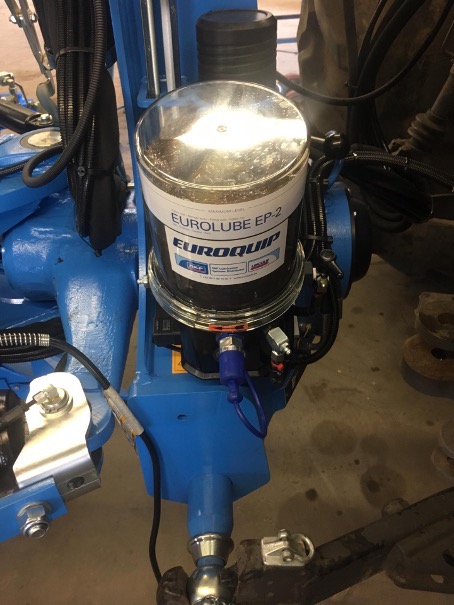
Smeersysteem op een Lemken ploeg voor de landbouw industrie

56%

of premature bearing failures are caused by contamination and poor lubrication

Dust, sand, soil and water together form an abrasive paste in the bearing. More than half of your bearing damage is therefore a lubrication problem, not a bearing problem.

up to 33%

less lubricant consumption

By switching from manual to automatic lubrication. Less grease, precisely dosed, at the right moment.

15–20 min

per machine per maintenance cycle

That’s how long correct manual lubrication takes. Automation gives that time back to your mechanic — and to your field planning.

40–60%

of your maintenance costs stem from poor lubrication

While lubricants themselves account for only 2 to 3% of your operating costs. The ratio between effort and impact is rarely this lopsided.

Why farms and agricultural contractors in the Benelux work with Euroquip

  • Official SKF partner — direct access to the complete SKF and SKF Lincoln range, technical support and warranty terms.
  • Certified installation of lubrication systems — from system design and line routing to commissioning, adjustment and training of your drivers and mechanics.
  • Retrofit on existing machines — you don’t need to buy a new machine to lubricate automatically. We fit the system to what you already have, regardless of the brand.
  • We know field conditions — vibration, dust and sand, high-pressure cleaning after the season, and the difference between a point that turns every day and a point that works three weeks a year.
  • Installation outside the season — we plan around your crop calendar and winter storage, not the other way around.

Frequently asked questions

With a 58% share of the cultivation processes — from ploughing to baling — the tractor remains the workhorse of the farm. And that is exactly where the problem lies: lubrication is considered maintenance, so it happens when the machine is standing still. That is not the moment the bearing needs fresh grease. Automatic lubrication greases while the tractor is out in the field, and saves around 200,000 tonnes of grease worldwide every year — equivalent to roughly 300,000 tonnes of CO₂.

Sources: SKF Lincoln publications on lubrication solutions for agricultural machinery.
Your results depend on the number of machines, the number of lubrication points and your current lubrication practice — we map this out during a machine scan.

Four levels of lubrication:
where does your machinery stand today?

Not every machine needs the same level of lubrication. A tedder that runs twenty days a year needs something different from a tractor with two thousand operating hours. SKF Lincoln builds the four levels modularly, so you can choose per machine and expand later. Together with you, Euroquip determines which level pays off fastest on which machine.

Level 1 · Basic

Manual lubrication

The right tools for points you deliberately keep manual

  • SKF TLGB 1886-E / TLGB 21 — 20 V Li-ion battery grease gun with two-speed gearing and (on the TLGB 21) an integrated grease meter for precisely measured lubrication.
  • 1142 / 1151 / 1035 — manual grease guns, optionally with flexible hose or as a complete set.
  • LAGN 120 — grease nipple kit with 120 conical nipples, to standardise your nipples across your entire fleet.

Strengths: low investment, direct control, suitable for machines with few operating hours, long intervals and easily accessible points.

Limitations: the dosing depends on who does the round and how much time they have; at the peak of the season, that’s the first thing to go. Moreover, the critical points are often at the bottom, at the back or under a guard — exactly where a round is silently skipped.

Level 2 · Consolidation

Semi-automatic lubrication

Bringing multiple lubrication points together into one central nipple

  • SSV / SSVD — (adjustable) progressive divider block that positively distributes grease from a single supply point to multiple points.
  • SALK lubrication kits — ready-made kits for 6 to 12 points including lines, specifically designed as the first step towards automation.
  • H and T lines — custom-made and protected, to suit the layout of your machine.

What it delivers: instead of searching for twelve separate points in the field, your mechanic greases one central nipple. The distribution is mechanical and positive: if one outlet blocks, the entire block stops — so a fault becomes visible instead of going unnoticed.

Ideal for: trailed implements that stand idle most of the year and points that are only accessible when the linkage is raised.

Level 3 · Continuous · Most popular on tractors and harvesters

Fully automatic lubrication

The right lubricant in the right quantity, while the machine is working

  • CLP / P203 — electrically driven grease pumps (ideal for medium to large machines with many points).
  • AECP — automatic electric cartridge pump for standard 420 ml grease cartridges (IP 6K9K rated, resistant to extreme weather conditions and high-pressure washing).
  • OCL-M chain lubrication kit — mechanically driven oil system that lubricates your drive chains only when they are actually running.

Why this matters so much in agriculture:

  • Lubrication takes place while the machine is working — exactly when the bearing and bushing need the lubricating film the most.
  • The grease film stays under constant pressure. Dust, sand and mud are pushed out of the bearing instead of being drawn in.
  • The dosing is fixed, which not only prevents over-greasing but also prevents grease being lost on fields and pasture.
  • The lubrication round disappears completely from the critical path of your harvest days.

Level 4 · Data

Connected lubrication (SKF eLube / IoT)

See what your lubrication system is doing, without driving out to the field

  • CLP Smart / P253 Smart — connected grease pumps with three operating modes: time-controlled, counter-controlled and progressive cycle-controlled. The P253 also features visual level monitoring and a stirring paddle.
  • Datalog controller & SKF eLube app — collects log data and communicates wirelessly with your smartphone via Bluetooth.

What you can do with it:

  • Read the fill level, operating status and operating mode without stopping the machine or having to climb into the cab.
  • Spot a blocked line immediately on screen, instead of at the next workshop visit when the bearing has already failed.
  • Set up pump configurations and share them via WhatsApp or email — handy when machines are operated by different seasonal drivers.

Why this is relevant in agriculture: Agricultural contractors and large arable farms often have machines working at several (distant) locations at the same time. The log proves that lubrication was carried out perfectly: that is worth its weight in gold in a warranty dispute or when it comes to the trade-in value of the combine harvester.

ManualSemi-automaticFully automaticConnected
Lubrication during operationnolimitedyesyes
Consistent dosingnopartlyyesyes
Risk of over-lubricationhighmoderatelowlow
Labour time per cycle15–20 min/machinegreatly reducedvirtually zerovirtually zero
Reaching difficult pointsdepends on the roundvia central nipplecompletecomplete
Fault detectiononly once damage occursmechanically visiblevia the systemreal-time + alarm
Traceable maintenance historypaper logbookpaper logbooksystem-controlleddigital logbook

Want to know what your machinery loses every year to lubrication points that don’t get greased?

Tell us the number of machines, the number of lubrication points and your current lubrication frequency. We convert the labour time, lubricant consumption and avoidable downtime into an annual figure — and set the investment in automatic lubrication alongside it.

No obligations. Response within two working days.

Lubrication solutions per machine type for your farm or contracting business

Dust, soil, sand and water are part of the job — and they are poison for bearings, bushings and chains. Below are the four machine groups Euroquip is asked about most often, with their critical components and the matching SKF Lincoln setup.

Tractors


Why it’s critical: with a 58% share of the cultivation processes, the tractor is the workhorse of every farm. Downtime costs not only the tractor, but every implement attached to it. Because lubrication is seen as maintenance work, it usually happens when the tractor is standing still — exactly the moment when bearings don’t need fresh grease.

Critical components: suspended front axle, rear axle bearings, steering rods and ball joints, hydraulic pumps, and the articulation joint (on articulated models).

Indicative number of lubrication points: 25 – 60 per tractor. (To be validated during the machine scan.)

Typical setup: progressive system with a CLP or AECP pump and SSV/SSVD divider blocks. Where the tractor changes hands or works across multiple locations, CLP Smart with the eLube app is the logical choice.

Trailed implements, transport and tipping trailers


Why it’s critical: A tractor is only as versatile as its implements. Many of those machines stand idle most of the year and have to perform at their peak on the day they’re needed. Their lubrication history is often unreliable: the last lubrication round was a long time ago and nobody remembers which points were covered.

Critical components: wheel hubs, axle parts, spring packs, rockers and bushings, drawbar, hinges, brake cams and (chain-driven) mechanisms.

Indicative number of lubrication points: 40 – 90 per implement-and-trailer combination. (To be validated during the machine scan.)

Typical setup: semi-automatic (SALK kit) for low operating hours; fully automatic (CLP/P203) on trailers that run year-round. Balers get an OCL-M chain lubrication kit, which delivers oil exactly when the chain is running.

Combine harvesters, forage harvesters and specialised harvesting machines


Why it’s critical: A combine harvester cuts and threshes at the same time, all of it dependent on controlled friction. On top of that, potato and beet harvesters literally run in the sand. With these machines, the harvest window is measured in hours, not weeks.

Critical components: axles, hydraulic cylinders, cutting and threshing components, auger and conveyor bearings, knives and the chain drives of the elevator or picking table.

Indicative number of lubrication points: 35 – 110 per machine, depending on the type. (To be validated during the machine scan.)

Typical setup: A robust P203 progressive system, supplemented with OCL-M for the chains. This is where a connected P253 Smart pays for itself the fastest: discovering a blockage or an empty grease reservoir in the middle of the harvest window is the most expensive breakdown of your year.

Sprayers and slurry tankers


Why it’s critical: Fertilising and crop protection take place within a narrow weather and regulatory window that leaves no room for an extra day in the workshop. In addition, grease that leaves the bearing here ends up in the soil or surface water much faster — a reason to review not only the dosing but also the choice of grease.

Critical components: axles and wheel bearings, drive shafts and universal joints, all pivot points of the (wide) spray boom, and pump bearings.

Indicative number of lubrication points: 40 – 90 per machine. (To be validated during the machine scan.)

Typical setup: A progressive system with CLP or P203, fed with LGGB 2 (an environmentally acceptable ‘EAL’ lubricant). The spray boom in particular, with its countless pivot points far from the cab and at height, is a component where manual lubrication structurally falls short.

Do you also work with large oil systems?

Do you use large volumes of oil for hydraulics, gearboxes, or circulation in your processes? Avoid unnecessary oil changes and reuse your industrial oil indefinitely, without any loss of quality.

Lubricants and diagnostic tools for agricultural machinery

A lubrication system is only as good as the lubricant that runs through it. Agricultural machines require greases that can withstand high shock loads, moisture, dust and fluctuating temperatures, and that remain pumpable in freezing conditions. Where the lubricant ends up in the soil, an environmental requirement comes on top of that.

SKF LGGB 2 — biodegradable for the field

LGGB 2 is an Environmentally Acceptable Lubricant (EAL). It meets minimum requirements for biodegradability, toxicity and bioaccumulation, drastically reducing the risk of adverse effects on the soil and the environment compared to a conventional grease.

Where it excels: It combines biodegradability with good low-temperature start-up performance and strong corrosion protection, and is suitable for medium to high loads (such as linkages, axles and spray booms).

Alternative (LGTE 2): An Ecolabel-certified alternative (for total-loss applications) with extremely high adhesion on pivot points.

SKF LGWA 2 and LGEP 2 — heavy pressure and high loads

LGWA 2: For situations with temperature peaks or directly wet conditions (such as muddy wheel bearings on harvesters or heavy tipping trailers). Has an operating range up to +140 °C (with short peaks up to 220 °C) and seals wet hubs superbly.

LGEP 2: The robust standard with EP additives for all heavily loaded, vibrating pin joints on site (lithium thickener).

Where extreme sub-zero temperatures are expected at start-up, our portfolio includes LGCC 2, a special cold-winter grease that remains reliably pumpable.

LFFM 100 and LHMT 68 — chain oils that stand up to sand

Chain oil that turns sticky is disastrous in agriculture: it immediately attracts dust, sand, stalks and soil, which on a pick-up or grain elevator is guaranteed to cause a breakdown in the middle of the harvest.

LFFM 100: Synthetic chain oil specifically for chains in food and agriculture. Very low residue formation (so it doesn’t clump together in the sand) and excellent corrosion protection in damp fields.

LHMT 68: For chain applications at medium temperatures, working seamlessly with SKF’s TLSD automatic lubricators.

Diagnostic and dosing tools

SKF TLSD single-point lubricators: Can be wired in and communicates with the machine PLC. Ideal for machines (and drive chains) that operate at long intervals. Lubricates as soon as the PTO turns.

SKF TLGB 21 PowerLuber: The smartest battery-powered grease gun in the world. Uses a built-in grease meter (and the ultrasonic TLGU-10 measurement) to determine exactly how much grease a pin needs during the manual round.

SKF eLube app: Wireless system diagnostics via your smartphone. Indispensable for monitoring an entire fleet that is spread across the region in July and August.

Bring your machinery to the right lubrication level

Start with one machine — usually the combine harvester or the tractor with the most operating hours. We map the lubrication points, calculate what the current approach costs you each year and propose the level that pays for itself the fastest.

Do you also work with large oil systems — hydraulics, gearboxes, circulation oil? Then take a look at SKF RecondOil for circular oil use.

Response within two working days · On-site machine scan · Service area: Belgium, the Netherlands and Luxembourg


Production
Nutrition
Agriculture
Earthmoving
Transport
Maritime
Paper
Steel
AutomoTIVE
Aviation
Mining
Recycling