+32 11 80 75 30

24/7 bereikbaar: +32 (0)11 80 75 30

Circular Oil Use & Filtration

Remove nanoparticles, save money, and reduce your CO2 emissions

SKF RecondOil2026-09-21T13:33:33+00:00
Close the oil loop: turn industrial oil into a circular asset with SKF RecondOil

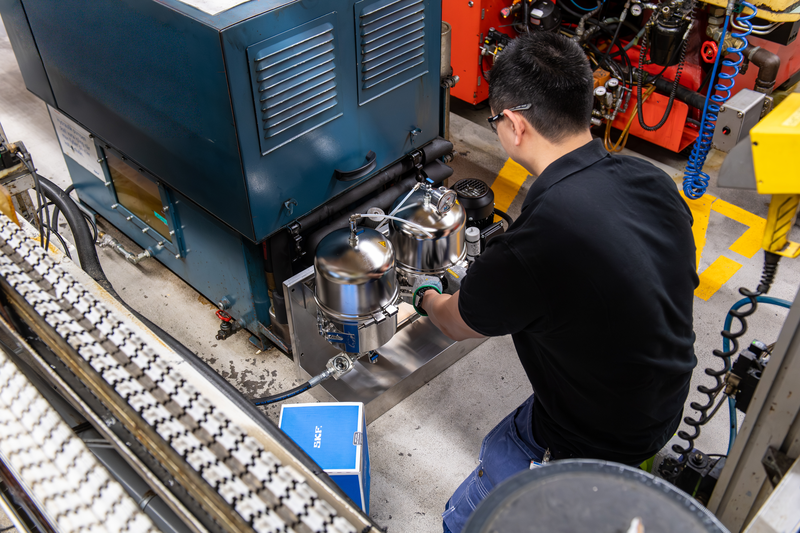
Remove contamination down to nanoscale, avoid oil changes, and extend the life of both your machines and your oil. Euroquip is your certified RecondOil partner for advice, installation, oil analysis and maintenance.

Official SKF partner · Certified installation · Oil analysis & reporting · Service throughout the Benelux
DST technologie, industriële olie regenereren, circulaire olie, oliehergebruik industrie, RecondOil Box, varnish verwijderen olie, nanodeeltjes olie, olie-analyse ISO 4406

up to 99%

less CO₂ per m³ of industrial oil

3,830 kg CO₂-eq. for the classic oil cycle versus 8.2 kg CO₂-eq. with the RecondOil Box.

< 0.1 µm

particles removed

DST-activated filters remove contamination, oxidation by-products and varnish well below the limit of classic filtration — while keeping active additives intact.

40%

of your maintenance costs are tied to the oil

Oil is typically only ~5% of the maintenance budget, but it influences up to 40% of maintenance costs.

0

oil changes as the goal

The same oil, used again and again. Unlimited in some applications. Oil as an asset, not a consumable.

Figures sourced from SKF RecondOil publications and independent life-cycle research.
Your actual savings depend on oil type, system volume and contamination level — we calculate this during the audit.

Why Belgian and Dutch industrial companies choose Euroquip

  • ✅
    Official SKF partner — no middlemen. Direct access to SKF RecondOil, technical support and warranty.
  • ✅
    Certified installation — from sizing and ATEX compliance to commissioning and handover to your team.
  • ✅
    On-site advice — we look at your reservoirs and your analysis reports before proposing anything.
  • ✅
    In-house maintenance & analysis — sampling, reporting and filter changes run through a single point of contact.
  • ✅
    Complete lubrication partner — Euroquip also supplies SKF central lubrication systems. Your oil and grease management with one partner.

Frequently asked questions

What does a RecondOil system cost?2026-08-31T14:48:34+00:00

That depends on system volume, oil type, and the chosen service level. There are flexible payment models: a one-off fee for hardware and commissioning, plus a monthly service fee for analyses, filters, and support — with the balance between the two adjustable. Request an audit for a calculation based on your figures.

For which oil types does RecondOil work?2026-08-31T14:48:21+00:00

DST can be applied to a wide range of industrial oils and metalworking fluids: hydraulic oil, gearbox oil, turbine oil, compressor oil, circulating oil, and cutting and cooling fluids. The final suitability of your specific oil is validated before commissioning.

How much CO₂ do I save with this?2026-08-31T14:48:07+00:00

Life-cycle research by the IVL Swedish Environmental Research Institute (2021) shows a climate impact of 3,830 kg CO₂-equivalent per m³ for the conventional oil cycle, compared with 8.2 kg CO₂-equivalent with the RecondOil Box — a reduction of up to 99%, depending on the energy mix.

Does my production have to stop for the installation?2026-08-31T14:47:50+00:00

No. The RecondOil Box is connected as an offline unit to your oil reservoir and runs alongside your process. In the reference cases, continuous 24/7 operation was maintained throughout the entire regeneration process.

Do the additives in my oil stay intact?2026-08-31T14:47:35+00:00

Yes. The DST process is designed so that the active additive functions remain intact while contamination and oxidation by-products are separated out. The oil is regenerated, not stripped.

What exactly is SKF RecondOil?2026-08-31T14:47:05+00:00

SKF RecondOil is a technology and service for regenerating industrial oil. At its core is Double Separation Technology (DST), which removes contamination from the oil down to the nano level so the same oil can be reused repeatedly instead of being replaced.

From linear oil consumption to a circular oil economy:
where does your installation stand?

Most industrial sites still manage oil linearly: buy, use, dispose, buy again. Each step up in the four levels below lowers your oil, waste and downtime costs. Together with you, Euroquip determines which level your installation is at today — and which step delivers the shortest payback time.
Level 1 · Basic

Changing on a calendar, not on condition

Traditional oil management (linear)

What it is: Oil is drained and replaced at fixed intervals, regardless of its actual condition. Used oil leaves the site as hazardous waste.

Limitations:

  • Planned downtime for every change, plus flushing and refilling.
  • High purchasing and disposal costs, both rising.
  • Full CO₂ burden from production, transport and incineration.
  • Still-usable oil gets thrown away; degradation isn’t addressed, just relocated.

Suitable for: small reservoirs with low contamination levels and limited criticality.

Level 2 · Contamination control

Classic oil filtration: essential, but not enough

What it is: Inline or offline filters that remove larger particles from the oil flow, typically from around 3–5 µm.

What it solves: Coarse contamination that causes direct wear and clogging. Classic filtration remains essential — DST doesn’t replace it, but builds on it.

What it doesn’t solve:

  • Sub-micron and nanoparticles slip through the filter medium.
  • Those particles accelerate oxidation and additive depletion.
  • Varnish continues to form and deposit.
  • Filters saturate quickly under high contamination, leading to frequent changes.

Signal for the next step: rising filter consumption, recurring MPC/varnish values, and oil that constantly needs to be brought “back to spec”.

Level 3 · Regeneration · Most popular

Your own oil, permanently regenerated on site

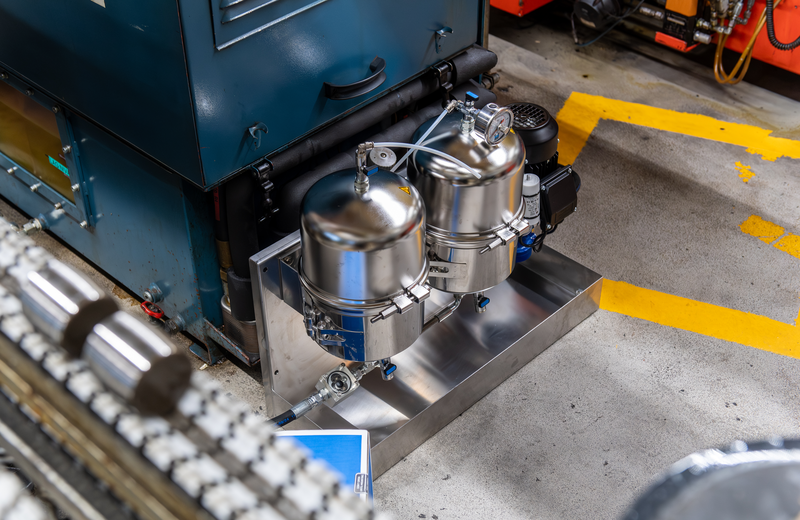
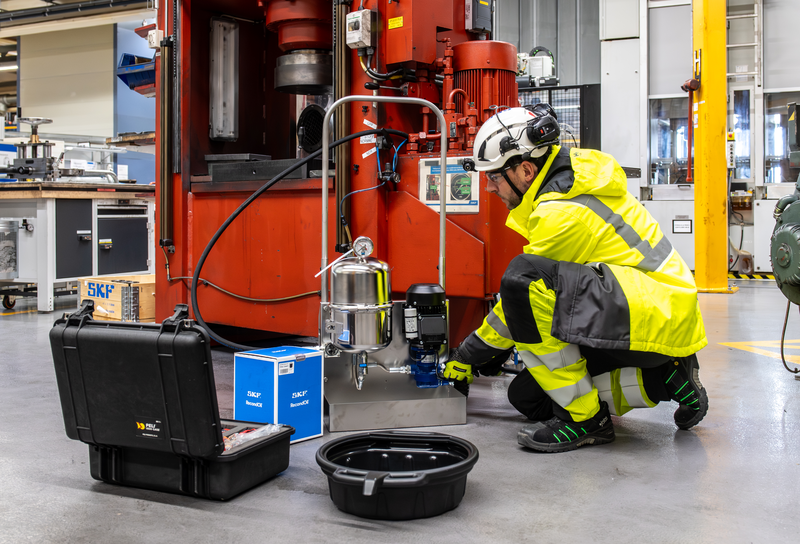
What it is: A RecondOil Box with DST-activated filters, installed by Euroquip on your system — as a kidney-loop (continuous) or as a batch setup.

What you gain:

  • Contamination and oxidation by-products removed down to < 0.1 µm, including varnish and water.
  • Active additives stay intact — it’s regeneration, not stripping.
  • Installation without production downtime: the Box runs offline alongside your process.
  • The component surfaces inside the installation get cleaned along the way too.

Compact, with limited power consumption; available in an ATEX version for zone-classified environments.

Level 4 · Fully managed

RecondOil as a Service: oil as a service

What it is: A service contract combining hardware, monitoring and maintenance. You’re not buying an oil project, you’re buying guaranteed oil quality.

Included:

  • Installation and commissioning of the DST system.
  • Periodic oil sampling and lab analysis, with clear reporting.
  • Condition-based filter changes (Core or Boost cartridges).
  • Flexible payment models: one-time installation plus a monthly service fee.

For whom: sites without their own oil expert, multi-site organisations, and any installation where oil condition is an audit point.

DST technologie, industriële olie regenereren, circulaire olie, oliehergebruik industrie, RecondOil Box, varnish verwijderen olie, nanodeeltjes olie, olie-analyse ISO 4406

Where RecondOil delivers the highest ROI

DST works in virtually every industrial oil flow — energy, manufacturing, maritime, metalworking, mining, pulp & paper. Four applications stand out in practice for payback time. If you recognise your situation here, an audit can usually be substantiated within a few weeks.

Hydraulic systems

Problem: Nano-contamination causes creeping wear on servo valves, pumps and seals. Water ingress accelerates oxidation. Symptoms like slow response and pressure loss are rarely attributed to the oil.

What DST does: Removes particles of every size down to nanoscale, plus water, so the oil regains its functional properties.

Field reference (Maritime, controllable-pitch propeller): Water content back from 2,010 ppm to 95 ppm and particles from 18.2 to 4.1 mg/100 ml over 180 days of continuous operation with a RecondOil Box on 1,800 litres.

Typical system volume: 500 – 20,000 litres · Setup: kidney-loop, continuous

Metalworking & cutting oils

Problem: Grinding particles get broken down by the machine into ‘ghost riders’ (too small for conventional filters), which keep circulating and degrade tool life.

What DST does: The chemical separation booster clumps particles, water and sludge together into larger clusters, which are then mechanically removed from the fluid entirely.

Why it matters: SKF applied this to the honing of bearing rings in their factory in Cassino (Italy) — a process where surface parameters directly determine service life.

Typical system volume: 200 – 10,000 litres · Setup: continuous or batch

Bearing and gearbox lubrication

Problem: In heavily loaded gearboxes, oxidation leads to varnish: a sticky lacquer layer that clogs valves and coolers. Classic filtration doesn’t remove dissolved varnish.

What DST does: Removes both dissolved and undissolved varnish, as well as the nanoparticles that trigger the oxidation. The problem is tackled at its source.

Field reference (Sugar mill, 12,000L): Varnish (MPC) from 32.9 to 3.2, and cleanliness back to the level of new oil. Estimated savings of AUD 50,000/year in breakdowns and oil changes.

Typical system volume: 1,000 – 30,000 litres · Setup: kidney-loop, continuous

Paper & steel processing

Problem: Large circulation systems with moisture, heat and constant contamination. Inline filters saturate faster than desired; every change is a risk of downtime.

What DST does: Keeps the entire oil volume continuously up to standard without interrupting the line (offline setup).

Field reference (Paper mill): Inline filter changes down from ~30 to 2 or 3 per month, cleanliness stabilised. Over 326 days, more than 431,000 litres of oil were treated without incidents. A second reference showed oil cleaner than new (MPC from 13 to 2) within 5 weeks.

Typical system volume: 1,500 – 50,000 litres · Setup: kidney-loop, continuous

Want to calculate how many litres of oil and how much CO₂ your company can save every year?

Tell us your system volume, oil type and current replacement frequency. We convert your annual oil purchases, disposal costs and CO₂ emissions into a circular scenario — and set a realistic payback time alongside it.

No obligations. Response within two working days.

The technology and services behind circular oil use

Double Separation Technology (DST) is the patented core of RecondOil: a two-stage combination of chemical and mechanical separation. Anyone who wants to regenerate industrial oil rather than replace it inevitably ends up at DST technology. Euroquip guides Belgian and Dutch industrial sites through that switch — from the first analysis to a running system.

1. Double Separation Technology (DST)

Step 1 — chemical separation: A precisely dosed separation booster acts like a chemical magnet: it attracts contamination particles, water molecules and degraded additives and makes them clump together into larger clusters, which settle as concentrated sludge and are removed.

Step 2 — mechanical separation: The oil passes through a specialised filtration system that completely removes the remaining booster. What’s left is ultra-clean oil, ready for reuse — with the active additive functions intact.

What sets it apart: DST doesn’t replace your existing filters, but goes further than where they stop. Because even the smallest contamination disappears, the ageing of the oil itself is slowed down. The same oil can therefore be used again and again — in some cases indefinitely.

2. Oil analysis & lab testing

Regeneration without measurement is guesswork. Every project starts with hard numbers. We measure: particle count (ISO 4406), varnish potential (MPC), water content, viscosity, oxidation level and additive condition.

For a new system we sample every 3 months. You get a report that says what the numbers mean for your installation, not just what they are.

3. The RecondOil Box

The physical installation, sized and commissioned by Euroquip. Configurations from 1 to 8 filter housings, operating from 0.8 to 5 bar.

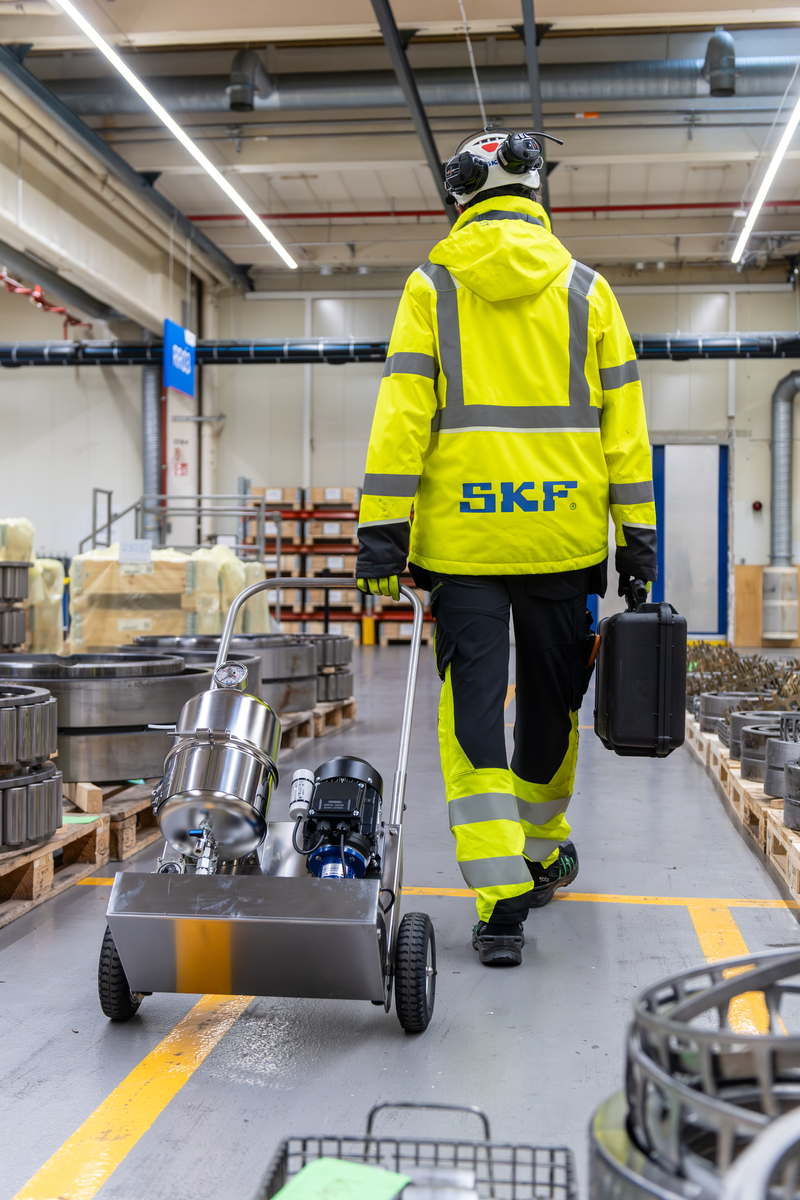
Installation is done offline (hose to tank and back). Available in an ATEX version, on a mobile chassis, or a heavy-duty stainless-steel frame.

4. Condition monitoring

Continuous digital insight into the state of your oil: trends in cleanliness, varnish potential and moisture, with alerts when a parameter drifts.

Maintenance thereby shifts from calendar-based to condition-based: filters get changed when the oil calls for it, not the diary.

Interested in an SKF RecondOil system?

Contact us today!

Jeff Vandebeeck
Jeff VandebeeckSales Coordinator

BE/NL/LUX
Dutch, English and French speaking

Take the first step towards circular oil use

A RecondOil project starts small: one oil flow, one analysis, one calculation. That quickly shows whether regeneration makes sense for your installation — and if so, how fast it pays for itself.

Response within two working days · Free review of your existing oil report · Service area: Belgium, the Netherlands and Luxembourg


Go to Top